
Robotic Welding Line Automation
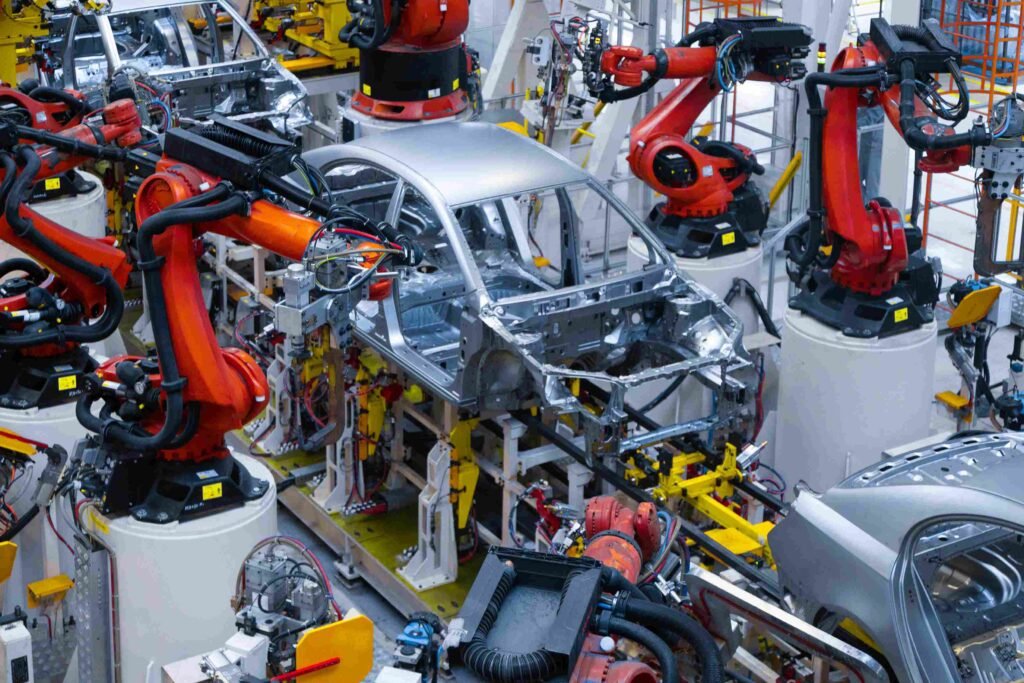
Robotic Welding Line Automation Company in Pune
Shine Robo AutomationShine Robo Automation Pvt. Ltd. designs, manufactures, and integrates robotic welding line automation systems for automotive and industrial manufacturers in Pune, Chakan MIDC, Bhosari MIDC, Ranjangaon MIDC, Talegaon, and Pimpri-Chinchwad.
Types of Robotic Welding Systems We Design and Integrate
We do not offer a single standard robotic welding product. Every system is configured to match your component geometry, production cycle time, material grade, and quality specification. Here are the welding automation systems we regularly design and commission for Pune clients:
MIG Welding Automation Systems
MIG (Metal Inert Gas) welding automation is the most common robotic welding application in Pune’s auto component sector. Our robotic MIG welding systems handle mild steel, high-strength steel, and aluminum components from 1mm to 25mm thickness. We use FANUC ARC Mate and ABB IRB 1600 series robots with OTC Daihen or Fronius welding power sources for consistent arc stability and low spatter.
Typical applications in Pune: chassis cross-member welding, exhaust pipe subassemblies, fuel tank brackets, and structural fabrication for agricultural equipment at Ranjangaon MIDC.
Spot Welding Robotic Lines — BIW Applications
Robotic spot welding is the core process in automotive body-in-white (BIW) production. Our spot welding lines use servo-controlled gun arms for consistent nugget diameter and penetration across 800 to 5000 welds per body. We integrate Yaskawa Motoman and FANUC spot welding robots with Obara and ARO gun arms for body panel, door assembly, hood, and roof welding applications.
Chakan MIDC’s OEM and Tier 1 plants are our primary spot welding line clients. BIW lines we have commissioned handle body production rates from 10 JPH to 60 JPH depending on model volume.
TIG Welding Automation Systems
TIG (Tungsten Inert Gas) robotic welding is used where weld aesthetics and metallurgical quality requirements are strict—stainless steel exhaust systems, aluminum aerospace components, and precision fabrication for defense and industrial equipment. We integrate ABB IRB 1410 and KUKA KR 6 R900 robots with Lincoln Electric or Miller TIG power sources for automated TIG welding.
Typical wall thickness handled: 0.5mm to 12mm stainless and aluminium. Weld positions covered: all-position capability including overhead and vertical seam welding with robot positioner integration.
Arc Welding Automation — Heavy Fabrication
For heavy structural fabrication — earthmoving equipment, material handling structures, pressure vessels, and agricultural machinery frames — we build robotic arc welding cells with FANUC M-20iD and ABB IRB 4600 series robots. These robots handle payloads up to 45 kg and work with positioner-mounted fixtures for full component access without manual repositioning.
Heavy fabrication clients in Pune’s Bhosari and Ranjangaon industrial zones use our arc welding cells for structural components from 3mm to 50mm plate thickness.
Technical Specifications — Robotic Welding Line Systems
Specification | Details |
Robot Brands | FANUC / ABB / KUKA / Yaskawa (Motoman) |
Welding Processes | MIG / TIG / Spot / Arc / Plasma (as required) |
Robot Payload Range | 6 kg to 500 kg (depending on gun + component) |
Robot Reach | 1,400mm to 3,500mm (model-dependent) |
Repeatability | ±0.02mm to ±0.08mm |
Welding Power Sources | Fronius / OTC Daihen / Lincoln Electric / Miller |
PLC / Control System | Siemens S7 / Allen Bradley / Mitsubishi iQ-R |
HMI | Siemens WinCC / Rockwell FactoryTalk |
Fixture Material | MS / EN8 / EN31 / Cast Iron (as per component) |
Component Thickness Range | 0.5mm to 50mm (process-dependent) |
Safety Standards | ISO 10218-1 / ISO 10218-2 / IS 13871 |
Safety Guarding | Light curtains / Safety fencing / Area scanners |
Cycle Time | Engineered to customer JPH/CPM requirement |
Commissioning Location | Customer plant — Pune and pan-India |
Industries We Serve for Robotic Welding Line Automation
We design and commission robotic welding automation systems for manufacturers across Pune’s industrial zones and beyond:
Automotive OEM and Tier 1 — Chakan MIDC and Talegaon. BIW spot welding lines, body panel assembly, exhaust system welding, and chassis subassembly automation for passenger car and commercial vehicle production. Production rates from 20 to 60 jobs per hour.
Auto Component — Tier 2 and Tier 3. Bhosari MIDC and Pimpri-Chinchwad. Bracket welding, structural subassembly, fuel system components, and seat frame welding. Typically single-cell or 2-station robotic MIG welding lines for medium-volume production.
Heavy Engineering and Construction Equipment. Ranjangaon MIDC and Sanaswadi. Earthmoving equipment frames, loader bucket welding, material handling structures, and agricultural equipment chassis. Heavy arc welding cells with robot positioners for large components.
Defense and Aerospace Fabrication. Precision TIG welding of aluminum and stainless steel components. Tight weld quality documentation requirements including X-ray inspection traceability.
Sheet Metal Fabrication. Enclosure welding, panel fabrication, and structural assemblies for electrical and industrial equipment manufacturers in Pune’s industrial belt.
Two-Wheeler and Three-Wheeler. Frame welding automation for two-wheeler manufacturers in Pimpri and their Tier 1 suppliers. High-speed spot and MIG welding lines for frame rail, swing arm, and fuel tank production.
Frequently Asked Questions
What is the cost of a robotic welding line automation system in Pune?
System cost depends on number of robots, welding process, component size, fixture complexity, number of stations, and PLC/conveyor integration requirements. A single-robot MIG welding cell with one fixture and basic safety guarding starts from approximately ₹25 lakh to ₹45 lakh. A 2-robot spot welding BIW station with tooling ranges from ₹60 lakh to ₹1.2 crore. A full multi-station robotic welding line with 4 to 6 robots, transfer conveyor, and full PLC integration typically runs from ₹1.5 crore to ₹4 crore depending on scope. Share your component drawing and production requirement with us at +91 9997775352 for a detailed project estimate.
Which robot brands do you use for welding automation?
We work with FANUC, ABB, KUKA, and Yaskawa (Motoman) — the four major industrial robot brands used in automotive and heavy engineering. We select the robot brand based on your existing plant infrastructure, available spare parts in your region, cycle time requirements, and component geometry. If you have a preferred brand, we integrate it. If you have no preference, we recommend based on application.
How long does it take to commission a robotic welding line?
Project timeline depends on scope and complexity. A single-robot MIG welding cell takes 8 to 14 weeks from order to commissioning — this includes fixture fabrication, robot procurement, programming, and site installation. A 4-robot multi-station welding line takes 16 to 24 weeks. We provide a detailed project schedule at the proposal stage with milestones for design approval, fixture ready, factory acceptance test, and site commissioning.
What welding processes can be automated with robotic systems?
We automate MIG welding, TIG welding, spot welding, arc welding, and plasma welding depending on your material and quality requirements. MIG is used for most steel structural and auto component welding. TIG is used for stainless steel and aluminium where weld aesthetics matter. Spot welding is used for BIW body panel assembly. Arc welding is used for heavy plate structural fabrication. We recommend the right process based on your component drawing, material grade, and production volume.
What after-sales support do you provide for robotic welding systems?
We provide 12 months of technical warranty support after commissioning. This includes on-site response within 24 hours for production-critical breakdowns at Pune locations, remote diagnostics for PLC and robot faults, preventive maintenance visits at 3-month intervals, and operator retraining if staff changes occur. Annual maintenance contracts (AMC) are available after the warranty period for ongoing line support. For our full range of automation services,
Other Automation Services by Shine Robo Robotic Solutions
- Welding and BIW Fixtures
- Line Automation
- SPM — Special Purpose Machines

