
SPM Services
Special Purpose Machine: Shinerobo Automation Pvt. Ltd.
aShineRobo Automation is a leading Special Purpose Machines Manufacturer and design provider. Our resident SPM specialist’s designers have a lot of experience and knowledge that they bring to the table. They create custom solutions that are made to meet the specific needs of each client, using their deep understanding of mechanical systems and their ability to pay close attention to detail. Our designers make sure that each project is done as efficiently and effectively as possible from the very beginning of the planning stage to the very end. The following are areas where our team of architects and designers has a lot of experience: developing custom BiW fixtures and SPM solutions tailored to your specific needs and requirements.
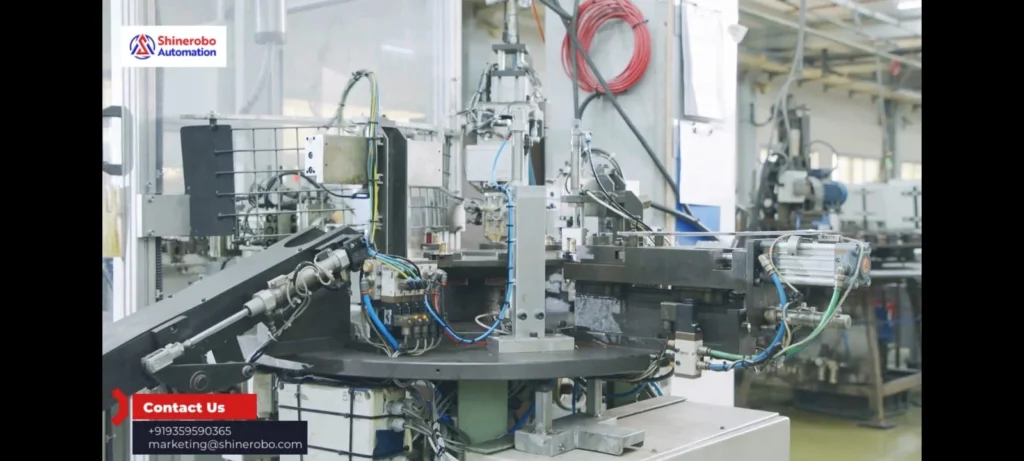
The scope of designing Special Purpose Machines (SPM) and Body in White (BiW) fixtures and components involves a range of tasks and considerations tailored to the specific needs of Special Purpose Machines Manufacturer in pune processes in automotive and other industries. Here’s an overview of the scope for each:
Special Purpose Machines (SPM) Design
Requirement Analysis
Understanding the specific manufacturing requirements and challenges that necessitate the development of SPMs. This involves collaborating with production engineers and stakeholders to identify the desired outcomes.
Conceptualization
Brainstorming and generating conceptual designs for SPMs that address the identified requirements. This may involve creative problem-solving to devise innovative solutions that optimize productivity, efficiency, and quality.
Mechanical Design
Creating detailed mechanical designs for SPMs using Computer-Aided Design (CAD)/ Catia/ Solid Work/ Solid Edge software. This includes specifying the structural framework, mechanisms, actuators, and other mechanical components required for the machine's operation.
Documentation
Creating comprehensive documentation including assembly drawings, part lists, operating manuals, and maintenance procedures to facilitate the manufacturing, installation, and maintenance of the SPMs.
Manufacturing Support
Providing support during the fabrication, assembly, and commissioning of the SPMs to ensure they meet the specified requirements and performance criteria. This may involve collaborating with vendors, suppliers, and technicians.
Electrical and Controls Design
Designing the electrical and control systems of SPMs, including sensors, actuators, PLC (Programmable Logic Controller) programming, HMI (Human-Machine Interface), and safety features. Integration with automation and Industry 4.0 technologies may also be considered.
Prototyping and Testing
Building prototypes of the SPMs to validate their functionality, performance, and reliability. Testing involves simulating real-world operating conditions to identify any design flaws or optimization opportunities.
Optimization
Iteratively refining the design based on feedback from prototyping and testing to enhance the efficiency, accuracy, and robustness of the SPMs. This may involve modifying mechanical components, fine-tuning control algorithms, or improving ergonomics.
Training and Knowledge Transfer
Conducting training sessions for operators, maintenance personnel, and other stakeholders to familiarize them with the operation, maintenance, and troubleshooting of the SPMs. Knowledge transfer ensures efficient utilization and maximizes the return on investment.
Body in White (BiW) Fixtures and Components Design
Assembly Fixture Design
Designing fixtures and jigs for the accurate positioning and assembly of body panels, sub-assemblies, and other components in the automotive body structure. This includes considerations for dimensional accuracy, accessibility, and ease of assembly.
Welding Fixture Design
Designing fixtures to hold and secure components during welding operations, ensuring precise alignment and weld quality. Fixtures may incorporate clamping mechanisms, locating pins, and adjustable features to accommodate variations in component geometry.
Robotic Welding Cell Integration
Integrating robotic welding systems with BiW fixtures to automate welding processes and optimize cycle times. This involves programming robot trajectories, specifying welding parameters, and ensuring compatibility with fixture designs.
Quality Assurance
Implementing quality control measures to ensure that BiW fixtures and components meet the required quality standards and specifications. This may involve inspection protocols, non-destructive testing, and statistical process control.
Tolerance Management
Managing dimensional tolerances and variations to ensure proper fit and alignment of BiW components during assembly and welding. This may involve implementing compensation strategies, adaptive features, or tolerance stack-up analysis.
Ergonomics and Safety
Incorporating ergonomic considerations and safety features into fixture designs to optimize operator comfort and minimize the risk of injuries. This includes designing fixtures with ergonomic access points, ergonomic handles, and safety interlocks.
Datum and Reference Systems
Establishing datum systems and reference points for accurate measurement, alignment, and assembly of BiW components throughout the manufacturing process. Datum features are critical for maintaining dimensional consistency and quality control.
Process Optimization
Continuously evaluating and optimizing BiW assembly processes to improve efficiency, productivity, and quality. This may involve analysing cycle times, identifying bottlenecks, and implementing process improvements such as lean manufacturing principles.
In summary, designing SPMs and BiW fixtures and components encompasses a wide range of tasks spanning conceptualization, design, prototyping, testing, documentation, manufacturing support, and process optimization. Collaboration between design engineers, production engineers, technicians, and other stakeholders is essential to ensure that the designed solutions meet the specific requirements and objectives of the manufacturing processes.
We use the latest Catia/ Solid Edge/ Solid Work/ AutoCAD software and simulation tools to create detailed designs that optimize performance, efficiency, and ergonomics.
Whether you require simple jigs and fixtures or complex automated SPM systems across Pune, we have the expertise to design solutions that meet your exact specifications.
Frequently Asked Questions (FAQs)
1. Which Pune-based Special Purpose Machine maker can you trust?
Shinerobo is a well-known maker of special-purpose machines in Pune,SPM machine supplier in Pune. They make SPM machines that are tailored to meet the needs of automation, assembly, testing, and industrial manufacturing.
2. What kinds of Special Purpose Machines does Shinerobo make?
Shinerobo is a well-known maker of special-purpose machines. They make custom SPM machines for the automotive, engineering, electronics, packaging, and manufacturing industries.
3. Do you sell SPM machines in Pune?
Yes, Shinerobo is one of the best SPM machine suppliers in Pune. They offer complete solutions, from designing and making the machine to installing it and getting it up and running.
4. What is an SPM machine, and where do you use it?
An SPM (Special Purpose Machine) SPM machine manufacturer in Pune ,is a custom-made industrial machine that can do certain tasks very well, quickly, and with great accuracy. A lot of factories and automated processes use these machines.
5. Why should you pick Shinerobo in Pune as your SPM machine maker?
Shinerobo is a top SPM machine maker in Pune because it offers custom solutions, has advanced engineering skills, meets high quality standards, delivers on time, and provides reliable support after the sale.
6. Do you make Special Purpose Machines that are made just for you?
Yes, Shinerobo is a professional Special Purpose Machine manufacturer that makes fully customised SPM machines to meet the needs of specific production and industrial uses.
7. Does Shinerobo provide installation and support for SPM machines?
Yes, Shinerobo offers full services, such as installing, testing, commissioning, and providing technical support for SPM machines in Pune and nearby industrial areas.

